
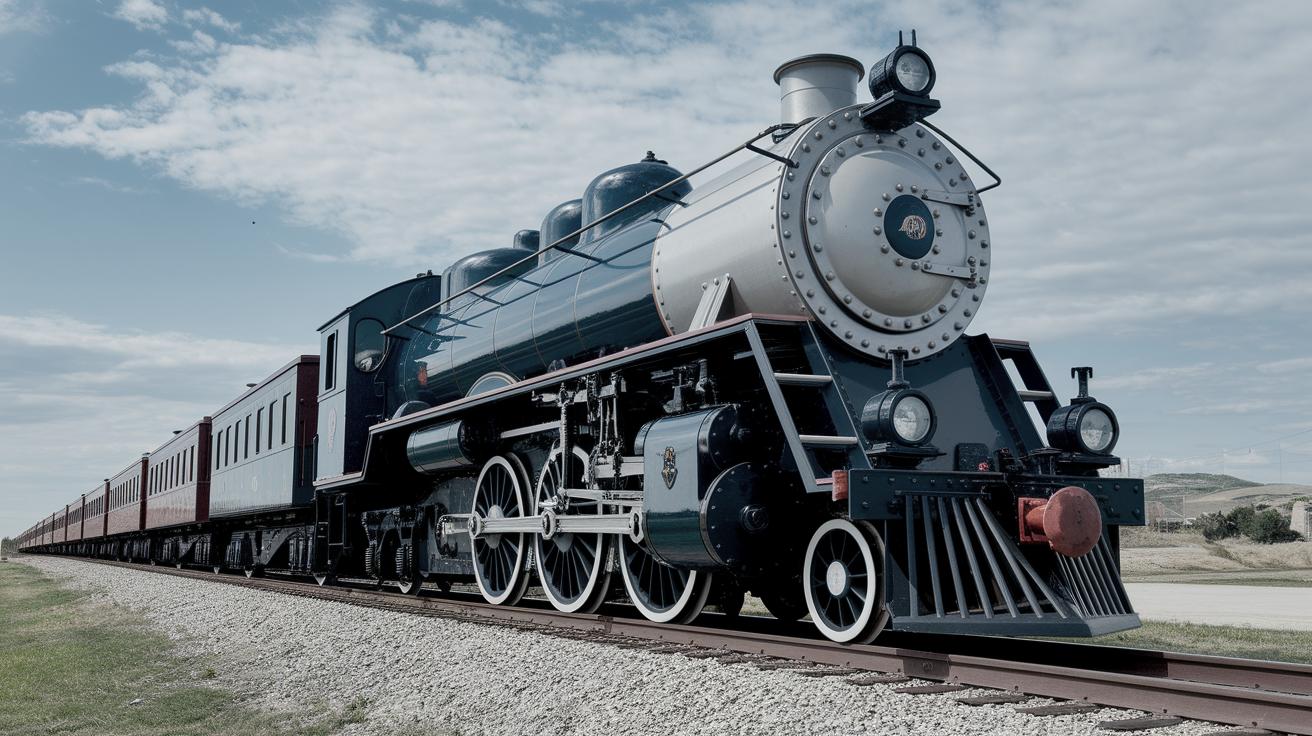
How Many Big Boy Locomotives Were Built?
In the annals of American railroad history, few locomotives capture the imagination quite like the Union Pacific Railroad’s Big Boy series. These colossal machines were introduced in the early 1940s to tackle the challenging terrain between Ogden, Utah, and the crest of the Wasatch Range. With only 25 of these engineering marvels ever constructed, each one played a unique role in the history of rail transport. In this blog post, we dive deep into the world of the Big Boy locomotives, exploring their beginnings, service, and eventual path to preservation. Join us as we take a detailed look at these legendary giants, encompassing everything from their prototype to their various public appearances and resting places in museums across the United States.
Union Pacific #4017 “Big Boy”
4017: National Railroad Museum, Green Bay, WI
The Union Pacific #4017, affectionately known as “Big Boy,” is one of the eight remaining locomotives of its class. This behemoth of steel and power currently resides at the National Railroad Museum in Green Bay, Wisconsin. Built by the American Locomotive Company (ALCO) in November 1941, 4017 served the Union Pacific with distinction. The locomotive’s fate took a turn in 1959 when it was retired and later donated to the museum in 1961, where it has been a significant attraction ever since.
Visitors to the National Railroad Museum can marvel at 4017’s enormous size, measuring over 132 feet in length and weighing approximately 1.2 million pounds with its tender. Equipped with a 4-8-8-4 wheel configuration, the locomotive’s design was tailored to navigate steep gradients and heavy loads, showcasing the zenith of steam locomotive technology. This iconic piece of transportation history allows guests to step back in time and imagine the era when steam power ruled the rails.
Photo Gallery | Union Pacific #4017 “Big Boy”
The National Railroad Museum in Green Bay offers a delightful photo gallery dedicated to Union Pacific #4017, chronicling its storied past and its presence in the 21st century. The collection features images from its working days, capturing the grit and determination of one of the most powerful steam locomotives ever built. These photos provide a window into the era of railroading that led to the development and use of such powerful machines.
Additional photographs showcase #4017 in its current home, depicting how it has been carefully preserved and displayed for public admiration. For rail enthusiasts and history buffs, this gallery serves as a visual journey through time, highlighting the ingenuity and skill that characterized the big train era, and emphasizing the value of preservation efforts to keep this history alive.
Contact Us
If you have further questions or would like to contribute additional information about the Big Boy locomotives, please feel free to reach out to our team. We are keen to connect with historians, rail enthusiasts, and locomotive experts to enrich our repository of knowledge on these magnificent engines.
You can contact us via email at bigboyinfo@railhistory.com or through our social media channels. We encourage any feedback, personal stories, or inquiries — your input is invaluable in our ongoing exploration and sharing of railway history.
Union Pacific 4000, The Prototype
4000: The OG Big Boy
The prototype of the Big Boy series, Union Pacific 4000, set the stage for what would become an iconic fleet of powerful locomotives. Unlike its successors, the 4000 was the testbed for numerous innovations that would later define the series. Sporting the initial 4-8-8-4 configuration, the prototype allowed engineers to fine-tune their design for heavy, mountainous service.
Its capabilities were evident from the start, with its ability to manage vast tonnage over the long haul, saving time and operational costs for the Union Pacific Railroad. Although it eventually fell out of service and was scrapped, the legacy of 4000 lives on through documents and photographs that detail its contribution to rail technology’s golden age.
4001:
The Union Pacific 4001 followed closely behind its predecessor, continuing to build upon the successes of the prototype. It featured reinforced frameworks and enhanced boiler efficiencies that addressed issues identified during the 4000’s service life. Now scrapped, 4001 was initially assigned to operational hotspots that tested its capabilities under heavy freight conditions.
Engineers experimented with slight modifications in its architecture, propelling the Big Boy units toward standardization, which paved the way for subsequent builds. Understanding the operational output of locomotives like 4001 helped in developing protocols for maintenance, increasing the reliability and durability of the remaining fleet.
4002: Advertising Star
Union Pacific 4002 gained a bit of fame as an advertising star for the Union Pacific Railroad. Unlike some of its counterparts, 4002 was photographed frequently and appeared in marketing material used by the railroad to highlight the reliability and power of their locomotives. It became the public face of the locomotives, often used to capture the imagination of potential customers.
The branding campaign successfully elevated Union Pacific’s reputation, bolstered by 4002’s sterling service record. Although no longer in existence, the locomotive’s place in promotional history lives on, offering a glimpse into how railroads leveraged their assets to capture market attention during a competitive era.
4003: Last “Serviceable” Big Boy
Union Pacific 4003 holds the rare distinction of being one of the last serviceable Big Boy locomotives. Before being retired, it underwent rigorous overhauls that kept it in top operational condition. This locomotive was one of the few that reached the furthest ends of its mechanical potential, setting benchmarks for performance.
Though its service days are long gone, 4003’s legacy persists through detailed technical journals that document its service life. These records provide invaluable insights into mid-20th century locomotive engineering and maintenance that continue to inform historical research today.
4004: Holliday Park, Cheyenne, WY
Union Pacific 4004 is one of the eight Big Boys that avoided the scrapyard and ended up in preservation. Now on display at Holliday Park in Cheyenne, Wyoming, 4004 attracts thousands of tourists and railway enthusiasts each year. It was donated to the city of Cheyenne in 1963, a testament to its significance and local appreciation.
This locomotive was treated with care, receiving aesthetic restorations to maintain its grand appearance, representing an era of industrial prowess. It’s a standing homage to the might of steam power and the engineering skills of the mid-20th century.
4005: Forney Transportation Museum, Denver
Union Pacific 4005 resides in the Forney Transportation Museum located in Denver, Colorado. It is famed for its role in a 1953 accident — a rare occurrence among the Big Boys — but fortunately, it was repaired and returned to service. Its tumultuous history adds to the allure and curiosity for visitors.
4005’s presence in the museum alongside other vehicles of historical importance contextualizes its industrial importance and the legacy it carries. It provides a tangible connection to the days when powerful steam engines were at the heart of rail transportation.
4006: National Museum of Transportation, St. Louis
Preserved at the National Museum of Transportation in St. Louis, Missouri, Union Pacific 4006 is another proud survivor of its class. Its formidable presence adds gravitas to the museum’s locomotive collection and educates the public about the transformative role of rail transport in the American westward expansion.
The museum offers detailed exhibits about 4006’s engineering and operational career, enlightening visitors about the advances in locomotive technology during its operational days. It remains an integral part of the locomotive’s narrative, providing context to its more than a decade-long service on the rails.
4007:
Unfortunately, details about Union Pacific 4007 remain sparse as records were not meticulously maintained. Like many others in the series, this locomotive served with distinction until operational constraints led to its retirement. It ultimately followed the path of many contemporaries to the scrapyard, leaving behind minimal documentation of its service life.
The story of 4007 highlights the gap in historical records surrounding some of the Big Boys. Efforts to piece together its history from scattered reports and personal accounts have provided a fleeting glimpse into its time on the rails, underscoring the challenges in preserving industrial heritage.
4008:
The narrative of Union Pacific 4008 is one of hard labor, tackling arduous routes and moving hefty freight across challenging terrain. It met a fate similar to many of its kin when it was retired from service and scrapped, deemed uneconomical to maintain as diesel-electric technology rapidly advanced.
Despite its physical absence, 4008’s operational history is kept alive through enthusiasts’ efforts to document its contributions, celebrating a bygone era where steam was synonymous with progress and power.
4009:
Union Pacific 4009 continued the tradition of excellence expected of the Big Boy series. Detailed operational records from its time in service illustrate its capabilities and the pivotal roles it played in freight movement. Its retirement signaled the end of an active service career, as dieselization began to dominate.
Though scrapped, 4009’s story is sporadically pieced together from historical archives and oral histories, ensuring that it maintains a place in the celebrated past of American railroading.
4010:
The brief service of Union Pacific 4010 was emblematic of the transitional period in railroading where steam and diesel coexisted. Its life was cut short as technological changes signaled the eventual decline of steam locomotives. Information on 4010 is sparse, a reminder of the ephemeral nature of many industrial histories.
Historians and rail fans continue to seek out memories and materials related to 4010, wishing to capture its entire operational story while acknowledging its part in a grander railway narrative.
4011: Last One Scrapped
Union Pacific 4011 holds the unfortunate distinction of being the last Big Boy to be scrapped. Its dismantling marked an end to an era of steam dominance. However, during its lifetime, it was a formidable force in freight movement, carrying heavy loads efficiently across the towering mountain ranges.
4011’s story is an example of the relentless march of progress; its replacement by more efficient and cost-effective technologies serves as a case study for scholars interested in the broader impacts of innovation in transportation.
4012: Steamtown National Historic Site, Scranton, PA
Union Pacific 4012 is preserved at the Steamtown National Historic Site in Scranton, Pennsylvania, serving as an educational showcase for visitors interested in railway history. As one of the biggest attractions, it draws significant attention from both history buffs and the general public alike.
The interpretive programs at Steamtown encapsulate the engineering marvels represented by the Big Boy series, emphasizing how these steam giants maneuvered massive freight assignments across the country, leaving a lasting impression on industrial transportation.
4013: Last Revenue Run. July 21, 1959
Union Pacific 4013 holds a special place as the locomotive that completed the last revenue-generating trip of the Big Boy series on July 21, 1959. Its final run closed the chapter on an era defined by impressive engineering and energy-intensive transportation.
While eventually retired and scrapped, the significance of 4013’s final journey remains a momentous point in rail history, signaling both an end and a progression towards an evolving, modern transportation network.
4014: UP Steam Shops, Cheyenne, WY
One of the most celebrated steam locomotives, Union Pacific 4014 was restored to operational status and remains active with the Union Pacific’s heritage fleet. It initially appeared at railfan events and made excursion runs much to the delight of thousands of onlookers.
Preserved in the Union Pacific Steam Shops in Cheyenne, Wyoming, 4014 is a key ambassador for American steam railroading’s rich history and enduring public fascination. Its operational status is a tribute to the dedication of those working to preserve this vital piece of rail history.
4015: Last to Run, First Scrapped
Union Pacific 4015 is often remembered as one of the last of the Big Boys to operate, but paradoxically, it was among the first to be scrapped. Its operational timeline is a reflection of the swift transition that occurred across the rail industry, as steam reliability and diesel efficiency headed in opposite directions.
The lessons from 4015’s service life have added to the collective understanding of steam-to-diesel transitions, yielding countless studies on engine performance metrics and economic viability during this transformative period.
4016: Bested the Diesels
Union Pacific 4016’s resilience during its tenure placed it among those that outperformed some early diesel-electric models in hauling heavy loads. Its robust design and engineering made it a reliable mainstay on challenging routes until new technologies finally replaced it.
4016’s operational superiority over the nascent diesel engines serves as a testament to the prowess of steam technology before the full rise of diesel, highlighting another aspect of the competition between these titans of transport.
4018: Museum of the American Railroad, Frisco, TX
Union Pacific 4018 has found a home at the Museum of the American Railroad in Frisco, Texas. It is preserved with care to illustrate the impact and significance of Big Boy locomotives on American rail travel. Famed for its service in moving heavy wartime freight, 4018 is honored as a locomotive that exceeded expectations.
The museum’s exhibits featuring 4018 delve into the political and economic circumstances that called for the mass production of these massive machines, offering visitors a comprehensive understanding of their development and utilization. It’s a powerful reminder of the technological advancements during and post-WWII period.
4019: Wore “Elephant Ears”
Union Pacific 4019 is noted for the unique modification that included “elephant ears.” These smoke deflectors were crucial components that aided in directing exhaust away from the engineer’s line of sight, demonstrating yet another fascinating facet of Big Boy design ingenuity.
Despite its early retirement and subsequent scrapping, the innovative design features like those on 4019 have been preserved through photographs and technical drawings, inspiring future locomotive enhancements and railroad engineering solutions.
4020: First of the 1944 Class
Union Pacific 4020 was the first locomotive of the 1944 class of Big Boys, representing the peak of steam locomotive enhancements designed during this period. It pioneered slight adjustments in technology over previous builds, primarily aimed at optimizing performance and extending service life.
When 4020 eventually ended its service, it was testament to the rapid evolution of railroad technology, as diesel-electric locomotives began to surpass steam engines. Historical records capture its short yet impactful service life, leaving behind insight into the operational strategies of its era.
4021: Mileage Champ of 1944 Graduates
Among the 1944 graduates, Union Pacific 4021 distinguished itself as a mileage champion, proving its reliability over sustained runs. Its record exemplified the locomotive’s formidable work capacity, excelling in freight operations across demanding routes.
As with many from its cohort, 4021 faced the widespread phaseout of steam engines but is fondly remembered through records and tributes dedicated to immortalizing its herculean feats on the tracks.
4022: Stored as “Serviceable” in 1958
The unique tale of Union Pacific 4022 includes its storage status as “serviceable” in 1958 during the twilight of the steam era. This designation indicated that it was maintained in prime working order, ready to be called into service if needed, as diesel engines gradually overtook the rail network.
4022’s serviceable status, however short-lived, reflected an era of cautious transition, as management weighed the merits of emerging diesel technologies against the proven heavy-haul capabilities of steam locomotives.
4023: Lauritzen Gardens, Omaha, NE
Union Pacific 4023 is proudly displayed at Lauritzen Gardens in Omaha, Nebraska. It serves as an inspiring monument to the city’s rich history in railroading. Its strategic placement alongside other exhibits pays homage to the legacy and cultural impact of the Union Pacific Railroad.
4023’s preservation signifies a commitment to keeping history accessible to future generations, situating Lauritzen Gardens as a pivotal point for learning about America’s rail transport evolution. Through its display, visitors gain valuable insight into both the technical and societal contributions of the Big Boy fleet.
4024: 1948 Railroad Fair Star
Union Pacific 4024 gained acclaim as a star at the 1948 Railroad Fair in Chicago. This exposition offered attendees a firsthand view of the power and glory of the Big Boy locomotives. It exemplified cutting-edge steam engineering and operational excellence, captivating audiences nationwide.
Sadly, despite its popularity, 4024 was eventually removed from service and scrapped. However, its role in the Railroad Fair remains part of railroad legacy storytelling, illustrating how these technological marvels captured the public’s imagination and support.
Next Steps
| Locomotive Number | Current Status/Location |
|---|---|
| 4017 | National Railroad Museum, Green Bay, WI |
| 4017 | Photo Gallery |
| Union Pacific 4000 | Prototype (scrapped) |
| 4001 | Scrapped |
| 4002 | Scrapped |
| 4003 | Last “Serviceable” Big Boy (scrapped) |
| 4004 | Holliday Park, Cheyenne, WY |
| 4005 | Forney Transportation Museum, Denver |
| 4006 | National Museum of Transportation, St. Louis |
| 4007 | Scrapped |
| 4008 | Scrapped |
| 4009 | Scrapped |
| 4010 | Scrapped |
| 4011 | Last One Scrapped |
| 4012 | Steamtown National Historic Site, Scranton, PA |
| 4013 | Last Revenue Run (scrapped) |
| 4014 | UP Steam Shops, Cheyenne, WY |
| 4015 | Last to Run, First Scrapped |
| 4016 | Scrapped |
| 4018 | Museum of the American Railroad, Frisco, TX |
| 4019 | Scrapped |
| 4020 | Scrapped |
| 4021 | Scrapped |
| 4022 | Scrapped |
| 4023 | Lauritzen Gardens, Omaha, NE |
| 4024 | Scrapped |

