
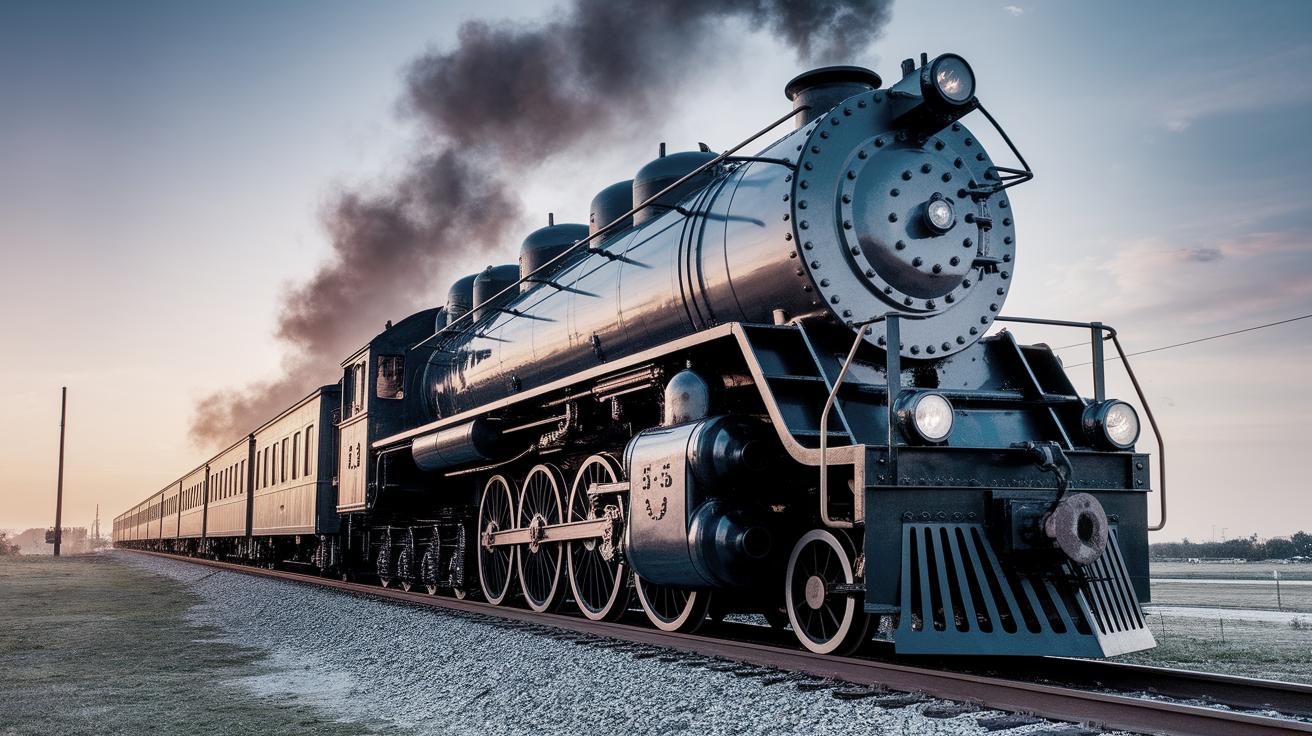
The Marvels of the World’s Most Massive Train Engines
Ever since the dawn of rail travel, humanity has been fascinated by the might and power of train engines. These behemoths of the rails have captured our imagination with their sheer size and engineering prowess. In this blog post, we’ll take a deep dive into some of the biggest train engines ever built. From the awe-inspiring size of the Norfolk & Western Y-Class to the coal-carrying might of the Yellowstone, each engine has its own story and significance. We’ll explore their technical specifications, historical contexts, and some intriguing facts that make these engines legendary masterpieces of engineering. Join us on a journey that celebrates the magnificence of these iron giants that revolutionized rail transportation.
Norfolk & Western Y-Class
The Norfolk & Western Y-Class locomotives were a series of articulated steam engines designed for heavy freight services. Known for their incredible strength, the Y-Class engines could efficiently haul massive coal trains across the challenging terrains of the Appalachian Mountains. These engines were Mallet-type locomotives, utilizing compound expansion to optimize steam efficiency across their large cylinders.
The Y-Class locomotives became famous for their durability and reliability, features that were crucial in the economically vital coal mining regions. They exemplified the pinnacle of steam technology during their time and served as a testament to American engineering ambition in the mid-20th century.
Did You Know?
The Norfolk & Western Y-Class engines were not only known for their power but also for their longevity. Many of them remained in service long after newer diesel engines had been introduced to the railroads, due to their robust construction and timeless engineering.
PRR Q2
The Pennsylvania Railroad’s Q2 class locomotives were among the most powerful steam engines ever constructed. With a unique duplex drive, these locomotives were designed to maximize power and traction while minimizing wheel slip. The Q2’s powerful design allowed it to excel at hauling heavy loads across the American heartland.
Measuring over 115 feet in length and tipping the scales at more than 1,080,000 pounds, the Q2 was a monumental piece of machinery. Its ability to maintain high speeds over long distances made it a valuable asset to the Pennsylvania Railroad during its years of operation.
Did You Know?
Despite their impressive specifications, the Q2 locomotives had a relatively short service life. The advent of more efficient diesel-electric engines quickly overshadowed these steam giants, leading to their phase-out by the early 1950s.
PRR S2
The PRR S2 stands as a fascinating chapter in railway history with its innovative direct drive turbine engine. The S2 was part of the Pennsylvania Railroad’s quest to find alternatives to traditional steam locomotives, incorporating strategies intended to push the boundaries of train speed and efficiency.
Although the S2 achieved high speeds, it faced challenges such as high fuel consumption and complex maintenance needs. Nevertheless, the S2 remains a symbol of what could have been had turbine technology better met the needs of its era.
Did You Know?
The PRR S2 was the only locomotive of its kind to be built using a steam turbine electric drive system. Its unique engineering made it one of the most ambitious projects of its time, with only one unit ever constructed.
Challenger
The Challenger locomotives were a fleet of very large articulated steam engines that played a crucial role during World War II. With their powerful design, they could handle both freight and passenger services, making them versatile assets for the Union Pacific Railroad.
Characterized by their 4-6-6-4 wheel configuration, these locomotives were among the largest and most powerful ever built. They are notable not only for what they accomplished during the war effort but also for their graceful profiles and longevity in the services they provided.
Did You Know?
Several Challenger units have been preserved and are on display across the United States, serving as historical reminders of this incredible era in American railroading.
PRR S1
The PRR S1 was a single prototype steam locomotive that stood out for its immense length and unique design. It was known for its duplex drive system and streamlined aesthetics, aimed at redefining how passenger services were managed.
With a design that stretched over 140 feet, the S1 was an engineering marvel of the 1930s. Despite its potential, operational challenges during its trials, including its sizable turntable demands, limited its production to only one unit.
Did You Know?
Nicknamed “The Big Engine,” the PRR S1 could theoretically reach speeds of up to 100 miles per hour, a remarkable feat during the time of its operation.
Erie Class P-1
The Erie Railroad’s Class P-1 was a steam locomotive built to handle the demanding freight needs of the east coast’s heavy industries. Designed with a focus on brute strength, these engines served the growing manufacturing and coal extraction sectors.
With a reputation for dependability, the P-1 class locomotives operated extensively across demanding routes, contributing significantly to the region’s economic growth during their era.
Did You Know?
The Erie Class P-1 was among the first to utilize a booster engine in the tender bogie to provide additional power on steep gradients, an innovation that became useful in challenging terrains.
XA Triplex
The XA Triplex locomotives of the Virginian Railway were unlike any other, possessing three sets of drivers to maximize power output. This unconventional design was a brave attempt to push steam locomotive limits by redistributing tractive forces.
Though ambitious, the Triplex’ inherent mechanical complexity and steam consumption rendered them inefficient for long-term service. Nevertheless, they remain a fascinating case study of locomotive innovation.
Did You Know?
Due to their complicated steam distribution, only a few Triplex locomotives were ever built, and they were usually restricted to coal fields where their extraordinary power was most required.
Allegheny
Designed initially for the Chesapeake and Ohio Railway, the Allegheny locomotives were amongst the world’s heaviest steam engines, intended to tackle the punishing Appalachian terrain with ease.
The powerful 2-6-6-6 wheel configuration allowed the Allegheny to pull enormous loads, making them ideal for hauling the coal and freight that powered America’s mid-20th-century industry.
Did You Know?
The Allegheny’s immense power came at a cost of high fuel and water consumption, making them one of the most resource-intensive locomotives of their time.
Big Boy
Known as the king of steam, the Union Pacific Big Boy is arguably the most famous locomotive in history. Its gigantic frame and unparalleled power made it a symbol of American industry.
Designed for transcontinental journeys, Big Boy locomotives were instrumental during their service period, demonstrating superior performance in both freight and passenger capacities. They remain beloved icons of railroading allure.
Did You Know?
Big Boys were engineered to navigate the arduous Wasatch Mountains, making them some of the most efficient and impressive mountain-climbing steam locomotives ever constructed.
Yellowstone
The Yellowstone type locomotives were developed to manage incredibly taxing freight routes, especially those courses that spanned the great distances and challenging gradients of the western United States.
With a staggering 2-8-8-4 configuration, Yellowstone engines were predominantly used for pulling enormous loads of iron ore, setting benchmarks in engine power and efficiency for their time.
Did You Know?
Their service in the unforgiving terrain of Montana and Wyoming laid the groundwork for successive innovations in locomotive technology that followed in the late 20th century.
Share this:
If you enjoyed this tour of the world’s largest locomotive marvels, please share with friends and fellow train enthusiasts. There’s always more to explore and learn about these steel giants.
Future Prospects
| Locomotive | Unique Feature | Service Period |
|---|---|---|
| Norfolk & Western Y-Class | Mallet-type articulation | 1930s – 1960s |
| PRR Q2 | Duplex drive power | 1944 – 1950s |
| PRR S2 | Turbine drive system | 1944 – 1949 |
| Challenger | Versatile freight/passenger use | 1936 – 1959 |
| PRR S1 | Streamlined, high speed | 1939 – 1946 |
| Erie Class P-1 | Booster engine addition | 1907 – 1954 |
| XA Triplex | Three sets of drivetrains | 1916 – 1920s |
| Allegheny | Heaviest steam engines | 1941 – 1956 |
| Big Boy | Mountain climbing capability | 1941 – 1959 |
| Yellowstone | Iron ore hauling | 1928 – 1962 |

